This article is (c)2022 Wisconsin Great Northern Railroad and the Midwest Rail Rangers, a 501(c)(3) non-profit historical partner. No part of the materials available through the www.MarkTwainZephyr.com and www.ZephyrHistory.com sites may be copied, photocopied, reproduced, translated or reduced to any electronic medium or machine-readable form, in whole or in part, without prior written consent of the above parties. Historic information: MRRC / P.O. Box 184 / Barron, WI 54812 / info@railrangers.org
Following the final run of the Mark Twain Zephyr in late April 1958, the CB&Q decided to store the train set at its shops in West Burlington, Iowa. As the 1950's rolled into the 1960's, the equipment was put up for sale by the railroad.
MARK TWAIN ZEPHYR PRIVATE OWNER #1:
The first private owner of the Mark Twain Zephyr train set was Charles "Frank" Dashner of Glenwood, Iowa. Dashner, who began making payments on the train in June 1960, planned to sell it to Cuba. His children recall several direct phone calls that Dashner had with Fidel Castro. However, an embargo by U.S. President John F. Kennedy -- and the discovery that Cuba had a different gauge of track than the United States -- put an end to that. Dashner then wanted to use the cars as a new railroad-themed restaurant and motel called "Transit Zephyr"; it would have been constructed near the interchange of Interstate 29 and U.S. Highway 34 in southwest Iowa.
However, before Dashner was able to proceed with his plans... and before the sale formally closed with the CB&Q... he passed away on February 24, 1961 at the age of 51. The train set was never moved from its location at the West Burlington CB&Q Yards before Dashner's untimely passing because full payment had not been made.
The death of Charles "Frank" Dashner meant the deal to close on the Mark Twain Zephyr ended up going to his heirs... his wife (Ann Dashner) and two then-teenaged children (Marilee Dashner and Charles Dashner, Jr.). None of the three family members really had a desire to continue with the restaurant idea of their late husband/father. A lawyer who was helping the family ended up trying to find a buyer for the train... as the estate continued to pay demurrage/rent to the CB&Q for storage of the Mark Twain Zephyr at the shops in West Burlington, Iowa.
The lawyer handling Dashner's estate contacted the St. Louis Dispatch newspaper about trying to sell the Mark Twain Zephyr. According to the May 4, 1962 article by reporter Jack Rice, the new asking price for the four cars and shell of the power unit (the diesel had been removed from it) was $10,000 --- which is approximately $95,200 in today's (2022) money.
MARK TWAIN ZEPHYR PRIVATE OWNER #2:
The above newspaper article concerning the status of the Mark Twain Zephyr caught the eye of prominent Mount Pleasant, Iowa, businessman Ernie A. Hayes. He decided to approach Dashner's estate with an offer of his own. In June 1962, an agreement for $6,500 (or approximately $61,880 in today's money) for the train set was reached. And with that... the Mark Twain Zephyr received its second private owner.
Shortly after his purchase, Hayes moved the Mark Twain Zephyr from the CB&Q Yards in West Burlington, Iowa to the Midwest Old Settlers & Thresher Association grounds in Mount Pleasant, Iowa... a distance of about 27 miles. A newspaper report from the time indicates that a house moving company was used to get the Mark Twain Zephyr from the Burlington main line in Mount Pleasant over to the museum grounds.
Hayes had a deep love for the city of Mount Pleasant and Iowa in general... and wanted the Mark Twain Zephyr to be a new tourist attraction in town. He thought having such a train would draw tourists - something Mount Pleasant desperately needed after it was bypassed to the north by then-new Interstate Highway 80.
MARK TWAIN ZEPHYR PRIVATE OWNER #3:
By 1968, Ernie Hayes was becoming more occupied with his insurance agency and other business interests. After six-and-a-half years of owning the Mark Twain Zephyr, he decided to officially donate it to the Midwest Central Railroad, which had been storing it for him. Hayes hoped the formal donation of the train would spur its restoration by Midwest Central. The railroad already operated narrow gauge steam train rides around the grounds of the Midwest Old Settlers & Thresher Association in Mount Pleasant. The Midwest Central Railroad, with Stan Mathews as President, officially became the third private owner of the Mark Twain Zephyr on December 17, 1968.
Unfortunately, the Midwest Central Railroad ran into several issues --- and the Mark Twain Zephyr train set ended up becoming a stationary museum piece instead of giving rides to passengers like Hayes originally envisioned.
On September 12, 1971, Jim Arpy, a reporter for the Quad Cities Times Democrat, wrote a scathing front-page newspaper article entitled "A Great Old Streamliner in Disgrace". It detailed the very poor condition that the Midwest Central Railroad let the Mark Twain Zephyr get into during the nine years it had been on their property.
Sadly, even the newspaper article did not put pressure on Midwest Central Railroad officials to make them realize the Mark Twain Zephyr would just continue to deteriorate even further under their care.
MARK TWAIN ZEPHYR PRIVATE OWNER #4: Operating out of the same park in Mount Pleasant, Iowa, the Midwest Central Railroad and the Midwest Old Settlers & Threshers Association went through some internal organizational changes during the mid-1970s. This resulted in the Mark Twain Zephyr changing ownership once again. The Midwest Old Settlers & Threshers Association was traded the train in exchange for other railroad equipment that the Midwest Central wanted, plus some additional monetary compensation.
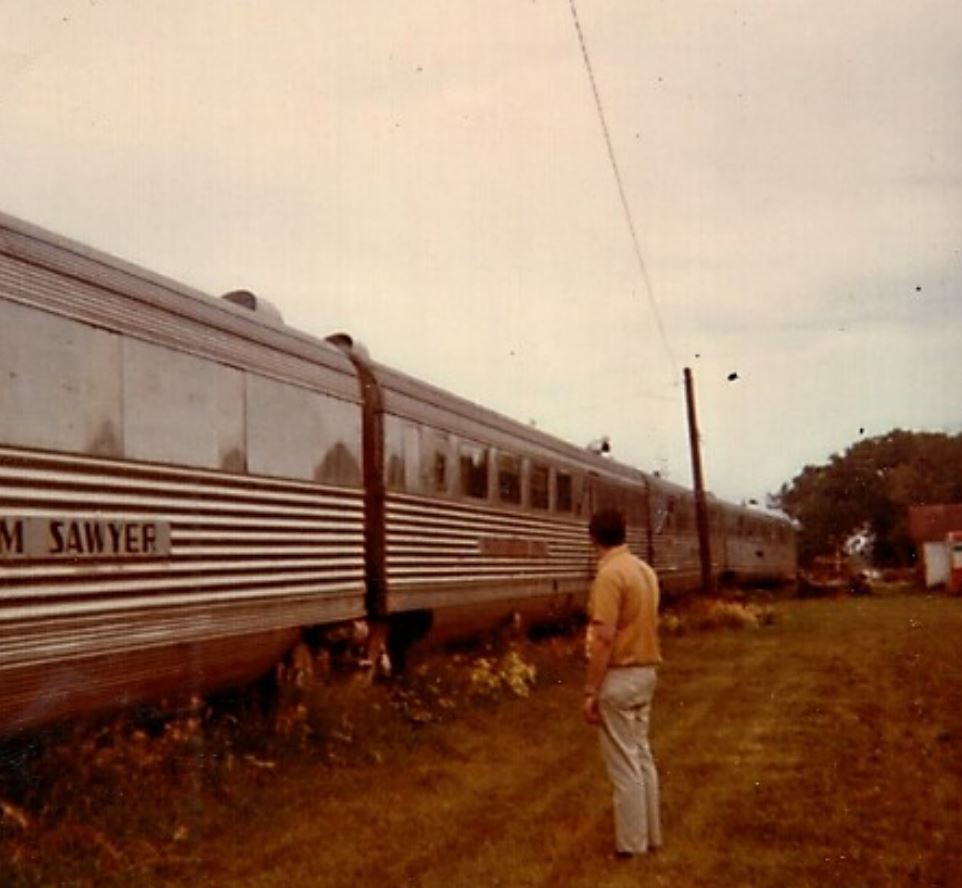
Despite the Midwest Old Settlers & Threshers Association becoming the fourth private owner of the Mark Twain Zephyr in December 1974, very little actually changed when it came to the train during the mid-to-late 1970s. The MTZ remained parked in Mount Pleasant's McMillan Park in pretty much the same spot it had been sitting in since 1962. No funds were raised for its reconstruction and once again minimal maintenance was done on the cars by the Threshers.
In 1978, the Midwest Old Settlers & Threshers Association welcomed Lennis Moore as their Chief Executive Officer. Much like their predecessors, Moore and his Board of Directors did not have a desire to restore the train set, which had been dilapidating for nearly two decades by this point. Moore did begin putting out the word that the organization would be interested in selling the Mark Twain Zephyr, if a potential buyer surfaced.
MARK TWAIN ZEPHYR PRIVATE OWNER #5:
In June 1979, the Mark Twain Zephyr train set was sold by Old Threshers for $50,000 ($198,005 in today's money) to Alexander J. Barket, Sr., a banker and land developer from the Kansas City, Missouri area. Barket served as one of the top executives with the Building Leasing Corporation, the Civic Plaza National Bank, and the Metropolitan Construction Company.
Barket was definitely no stranger to the restoration of former CB&Q Zephyr passenger trains. A full decade before his acquisition of the Mark Twain Zephyr, Barket bought one dozen cars of a Texas Zephyr train set (formerly one of the original Denver Zephyr train sets built in 1936) for $42,000 each. During the early and mid-1970's, the train was often seen parked at Kansas City Union Station. It was even given the name Civic Plaza National Bank Express (see photo below of former CB&Q car #230 "Silver Flash"). The train set was mainly used for business meetings and as a flashy and unique way to entertain clients and potential new customers... however it sometimes was also used for excursion trips around the Midwest.
In addition to the Texas Zephyr, Barket also purchased five cars from the former CB&Q "Train of the Gods" Nebraska Zephyr train set in 1975 for $52,000 each. The cars featured names such as "Apollo", "Mars", "Neptune", "Cupid", "Vulcan", "Mercury", and "Jupiter". (Yes, this was the sister train set of the former CB&Q "Train of the Goddesses" Nebraska Zephyr, which has been operating at the Illinois Railroad Museum since the late 1960's!). Barket also purchased six cars of a sister Denver Zephyr (he was not able to get the complete train set for this train because several cars were owned by another individual in South Dakota).
In October 1976, Barket sold nearly all 24 passenger cars that he owned to the Royal Saudi Railroad in Saudi Arabia (where they were used into the 21st Century and remain in storage today).
Barket obviously didn't get railroading fully out of his blood though, with his purchase less than three years later of the Mark Twain Zephyr train set.
In July 1979, Gerald "Skeeter" Hidy, a resident of nearby Batavia, Iowa, was contracted by the Old Threshers and Barket to move the train cars from McMillan Park to the railroad siding along the Burlington Northern in Mount Pleasant, Iowa. Hidy recalls the original plan was to then put the cars of the Mark Twain Zephyr back on the rails at Mount Pleasant and move them to Kansas City under its own power. However, that plan was nixed by the BN at the last minute. The railroad changed its mind and required the train to be transported on flat cars pulled by a freight locomotive. Virgil E. Coonrod of Cedar Rapids, Iowa, who owned a crane business, did the work of lifting the cars before they departed Mount Pleasant for good.
Extensive restoration work would be required before the Mark Twain Zephyr could be put into operation. Thus, instead of keeping the train cars at Kansas City Union Station, Barket opted to park them on a siding off of the Missouri Pacific Railroad, which led into an industrial park he owned in the Byram's Ford area of Kansas City.
Today, that same industrial siding, near the intersection of Denver Avenue and Manchester Trafficway, is long abandoned, but is visible on aerial photographs on Google Maps (Coordinates: 39.00'59.6"N, 94.31'35.9"W).
Barket planned to restore the Mark Twain Zephyr and possibly provide rides around Kansas City's Swope Park. Unfortunately, Barket never got to enjoy his acquisition. As the train cars were moving between Iowa and Missouri, Barket suffered an unexpected fatal heart attack at the age of 63.
It turns out that Barket, Sr., did not have a written will, which resulted in his estate being settled after multiple court hearings in 1980.
MARK TWAIN ZEPHYR PRIVATE OWNER #6: During the settlement of the estate, it was discovered that Barket took out a short-term loan from his friend Clarence Wilson, who was president of Westgate Bancshares, Inc. in Kansas City. According to Clarence's son, Ken, who was Vice President of the bank, Barket had a strong enough credit history that he did not even need to put up any collateral for the loan, however Barket offered Wilsons' bank the note for the Mark Twain Zephyr as a joke. However, Barket died before the loan was paid off... resulting in the bank owning a train they didn't want or know what to do with.
Ken Wilson recalls that some of his coworkers at Westgate Bancshares wanted to scrap the Mark Twain Zephyr for the value of the stainless steel, using the funds to pay off Barket's loan. However, Clarence and Ken not only saw the historic value of the train, but also considered it a piece of art worth saving... and convinced the bank's Board to let them try and find a buyer. Ken mentioned that he personally was tasked with the sale of the train during the early 1980s. A deal was worked out where the Mark Twain Zephyr would remain on the siding in the Byram's Ford Industrial Park in Kansas City until a potential new owner was found.
One of Ken's favorite memories from the time period the bank owned the train was receiving a phone call about the Mark Twain Zephyr from Canadian/American singer Neil Young. Young was interested in model trains and inquired about using the MTZ to travel between concerts on an upcoming tour. Ken mentioned that Young "knew his stuff" and understood the train had articulated passenger cars. Ken personally showed Neil around the train in Kansas City. Young did not end up buying the train, however, because of logistical problems -- primarily the fact freight railroads would not agree for the train to operate under its own power and would have to be pulled by one of their freight engines. Young wanted to arrive into a concert venue with the glistening shovelnose of the Zephyr pulling his train.
According to Ken Wilson, other potential buyers (that did not pan out for one reason or another) when Westgate Bancshares owned the train included the U.S. Olympic Committee in Colorado Springs, Colorado, and entrepreneur Ted Turner, owner of the Atlanta Braves and founder of CNN.
In order to know the value of the Mark Twain Zephyr, Ken Wilson recalls that Westgate Bancshares commissioned an in-depth appraisal report on the train, conducted by technical equipment appraiser Charles E. Cawthra. The report released in March 1983 valued the Mark Twain Zephyr at $600,000 "as-is", but had the value of $6,000,0000 if fully refurbished.
Ken Wilson also reached out to several newspapers and business journals across the country in an effort to find a new buyer for the Mark Twain Zephyr. One of the more interesting articles is below, written by Bill Granger with the Chicago Tribune, published on February 1, 1983.
Wilson pretended to be an "independent broker" for the article and did not name his father's bank who owned the train, as some on the bank's Board of Directors were embarrassed they acquired a train and were having a hard time getting rid of it. Wilson was quoted as saying the asking price was $500,000 (approximately $1,450,000 in today's money) and that several railroads, including ones in Saudi Arabia and Mexico would be possible new owners.
MARK TWAIN ZEPHYR PRIVATE OWNER #7: The seventh private owner of the Mark Twain Zephyr was David L. Simpson of Mission Hills, Kansas. Simpson was friends with both Clarence and Ken Wilson. He decided to purchase the train to both help take it off the hands of Westgate Bancshares... and because it was a "unique item" to add to his vast art and vehicle collections.
Dave was a successful college football player for Drake University (located in Des Moines, Iowa) in the late 1960s. He was then drafted in 1970 by the Buffalo Bills as an offensive tackle. Dave trained along side and recalled often playing cards with the team's famed running back, O.J. Simpson. Since they shared the same last name, the then-new rookies grew close. Before actually playing in his first NFL game, however, a career-ending injury changed Dave's focus to the real estate business in Kansas City. That is where he met the Wilsons and learned about the opportunity to purchase the Mark Twain Zephyr.

Portions written by Kandace Tabern & Robert Tabern
Charles "Frank" Dashner
(June 1960 - June 1962)

Charles "Frank" Dashner was the original private owner of the Mark Twain Zephyr.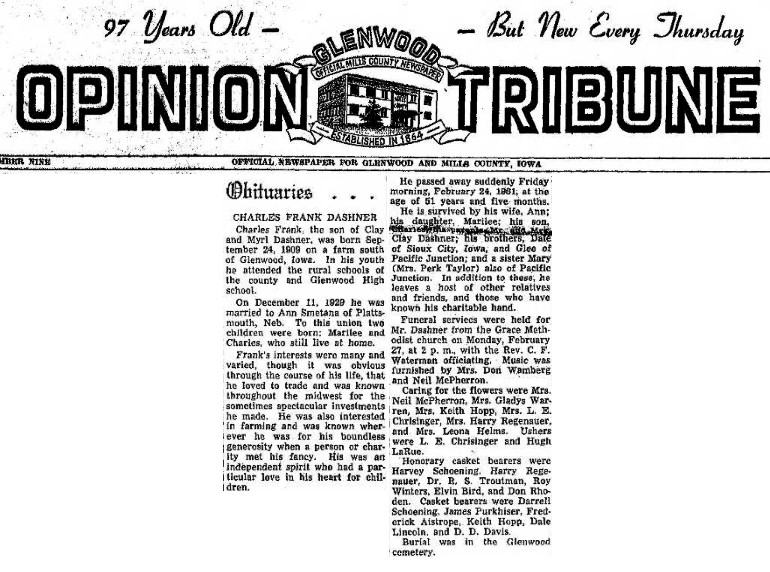
March 2, 1961 edition of the Glenwood Opinion Tribune featuring Dashner's obit
(Courtesy: Historical Department of Iowa)
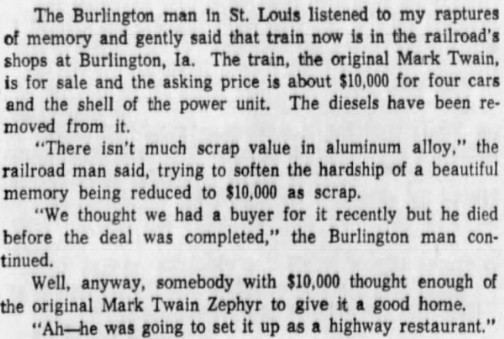
A portion of the May 4, 1962 newspaper article discussing the Burlington's desire to sell off the Mark Twain Zephyr (Courtesy: St. Louis Post Dispatch Archives)
Ernie A. Hayes
(June 1962 - December 1968)
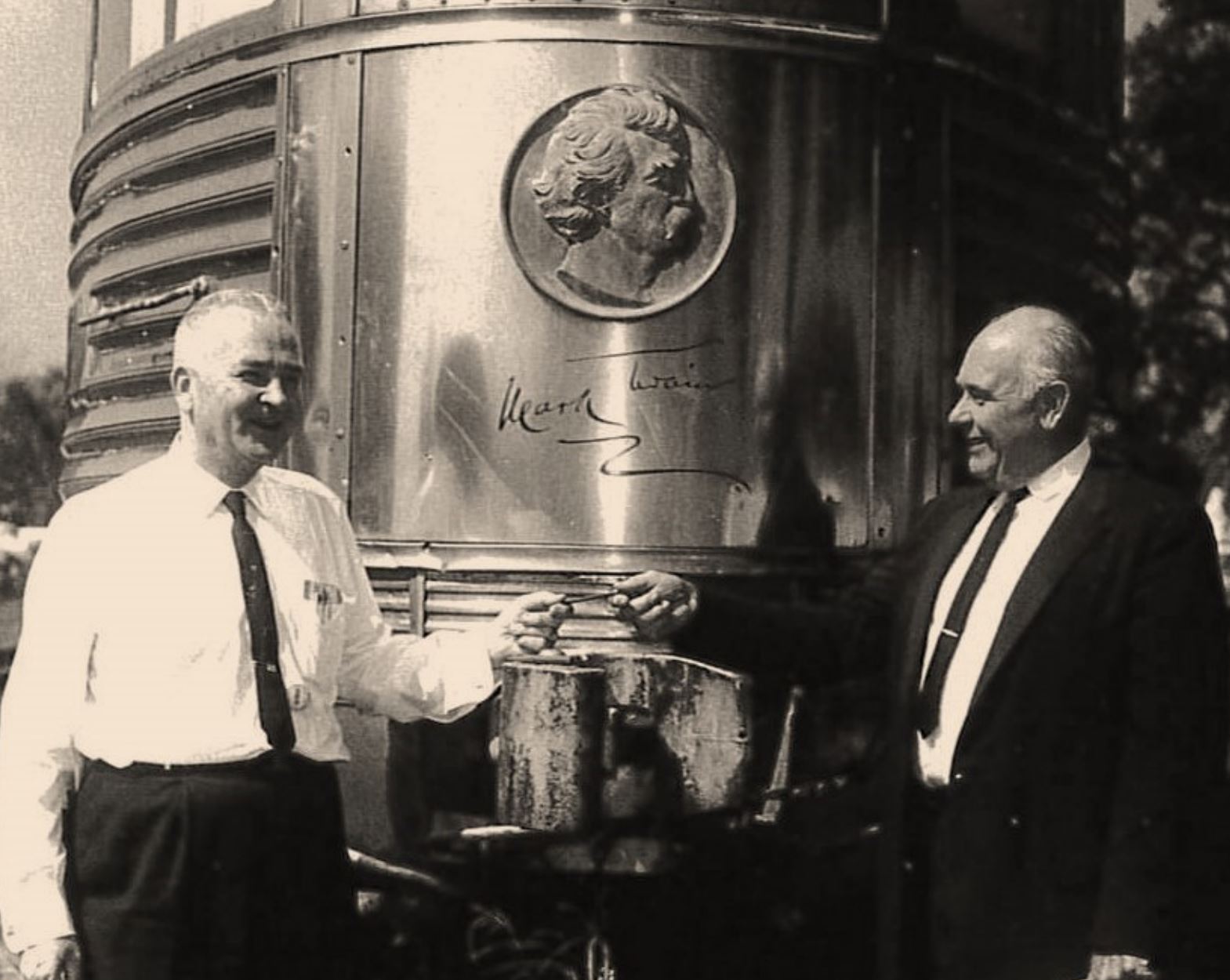
Ernie "E.A." Hayes receives the keys to the Mark Twain Zephyr from a CB&Q official.
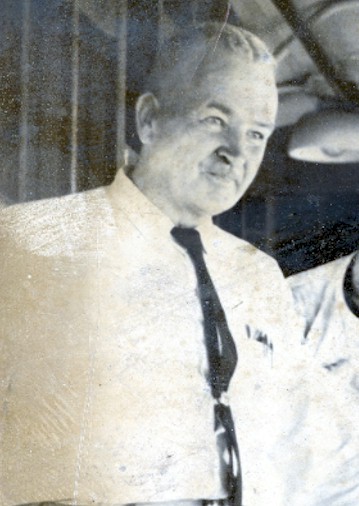
Ernie "E.A." Hayes was the second private owner of the Mark Twain Zephyr.
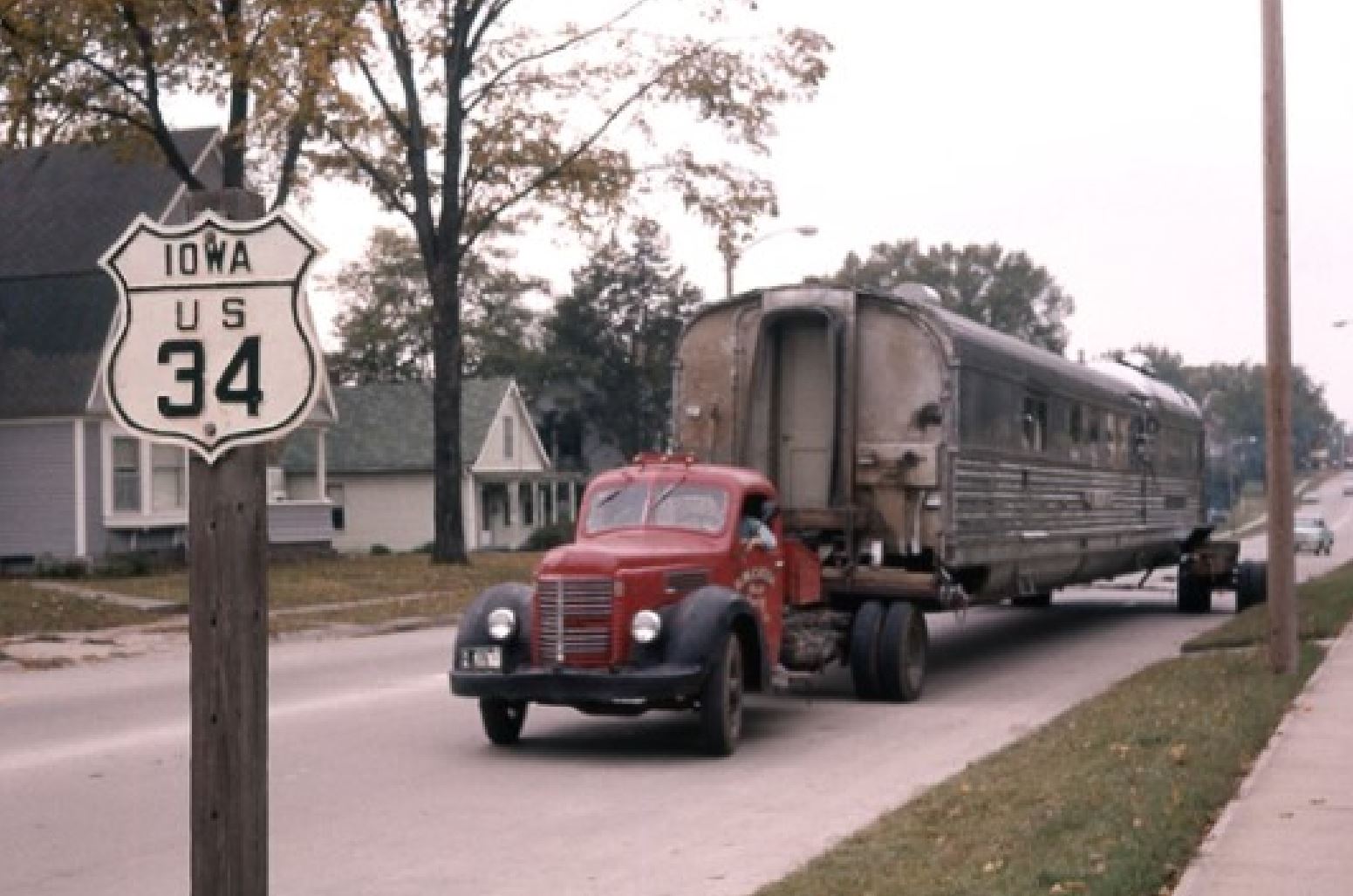
The Mark Twain Zephyr moves through Mount Pleasant, Iowa in Summer 1962.
The ultimate goal for Hayes was to restore the Mark Twain Zephyr and provide rides for passengers along a small loop track that runs through the grounds of the Midwest Old Settlers & Thresher Association in Mount Pleasant, where it was being stored. A newspaper report from 1964 indicates that while it was awaiting a new life, the "Becky Thatcher" baggage car of the Mark Twain Zephyr was used by a local Boy Scout group to build their HO model railroad layout in.
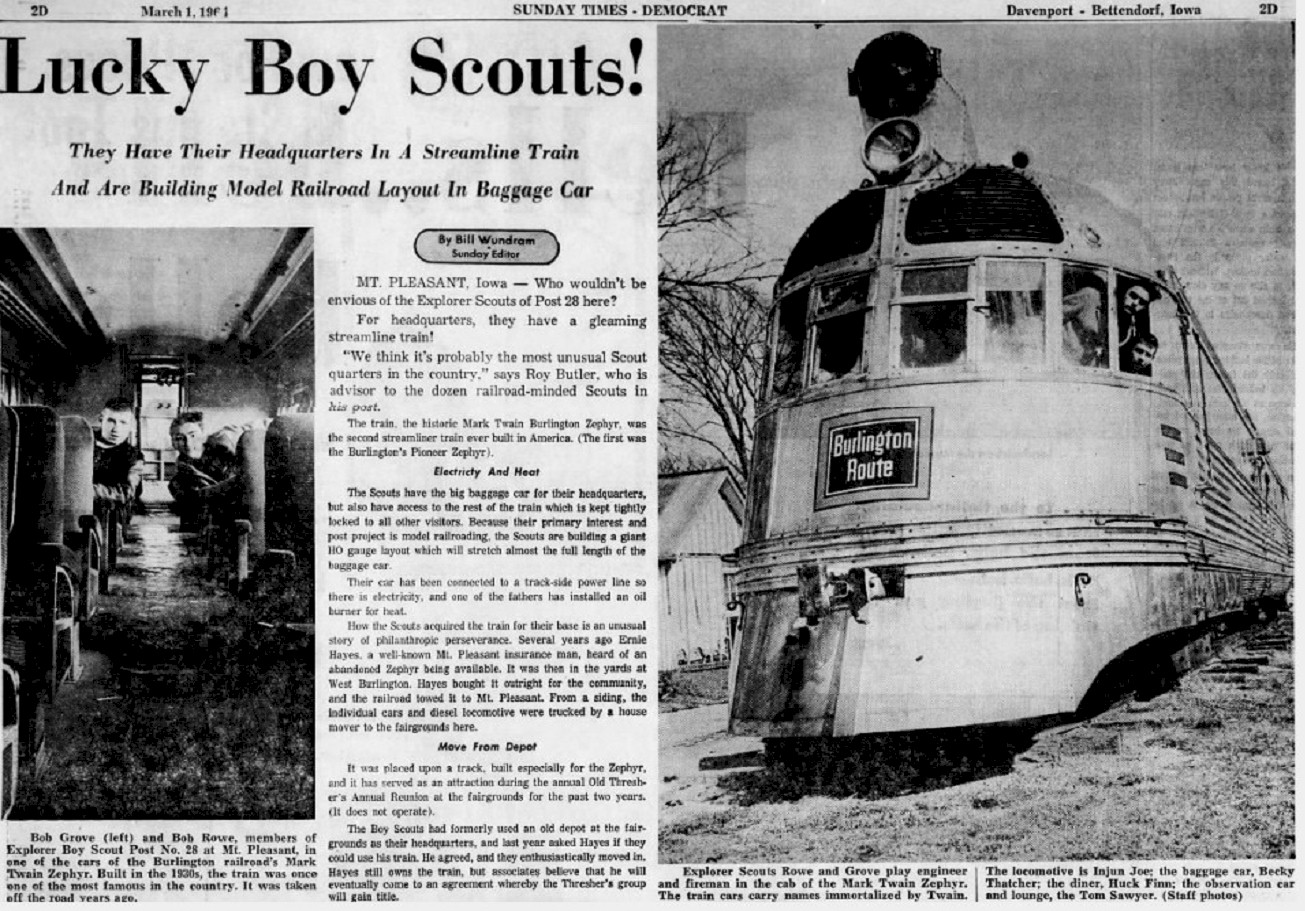
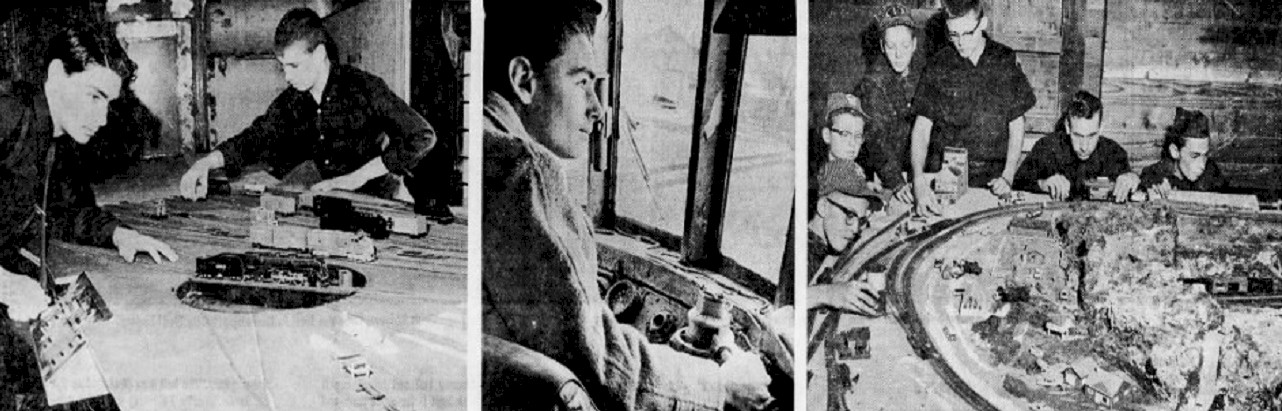
The March 1, 1964 edition of the Quad-City Times details a Boy Scout group who was allowed to use the Mark Twain Zephyr to build a model railroad layout. (Courtesy: Quad-City Times)
Midwest Central Railroad
(December 1968 - December 1974)
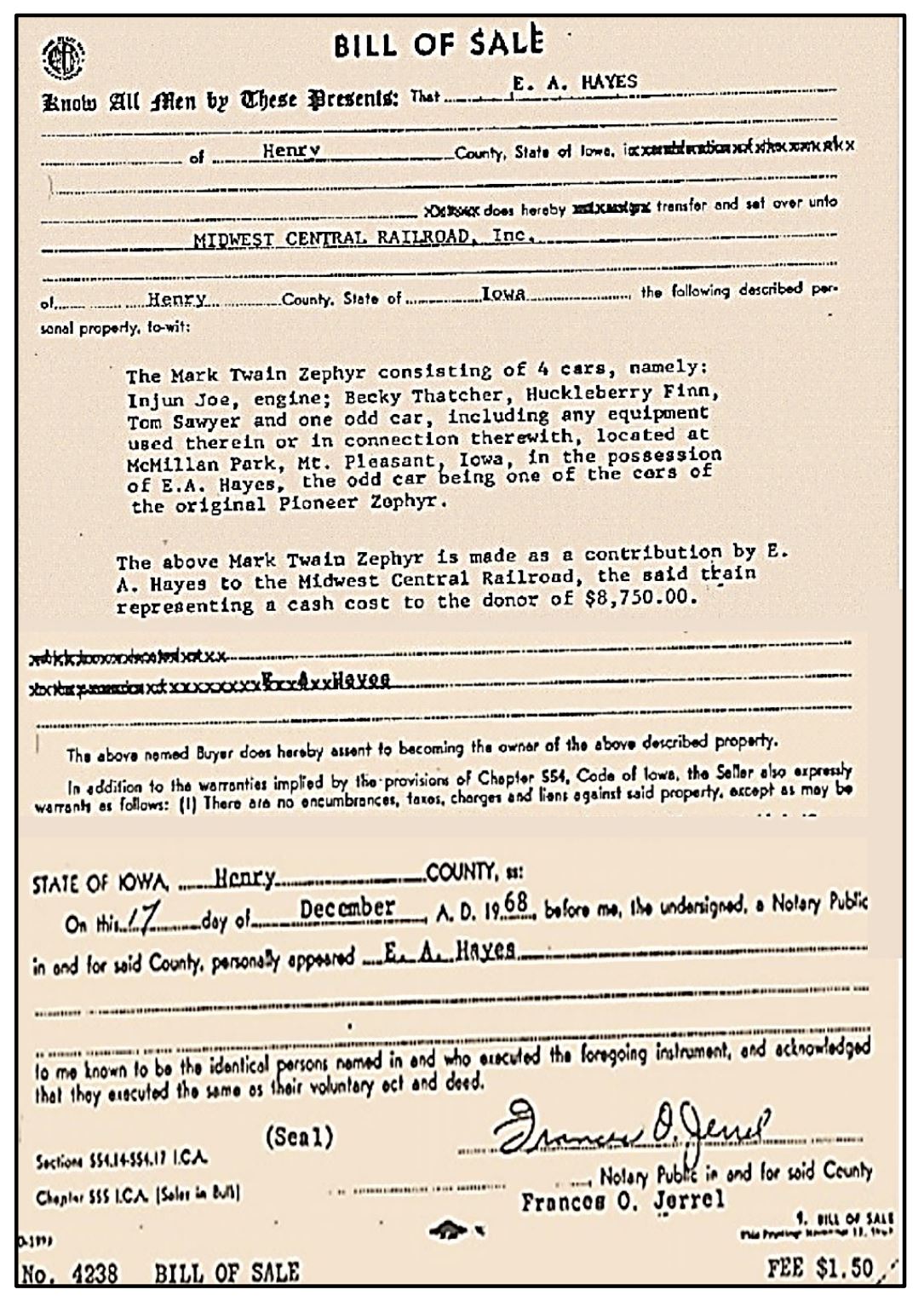
Above is Ernie Hayes' 1968 donation paperwork to the Midwest Central Railroad.
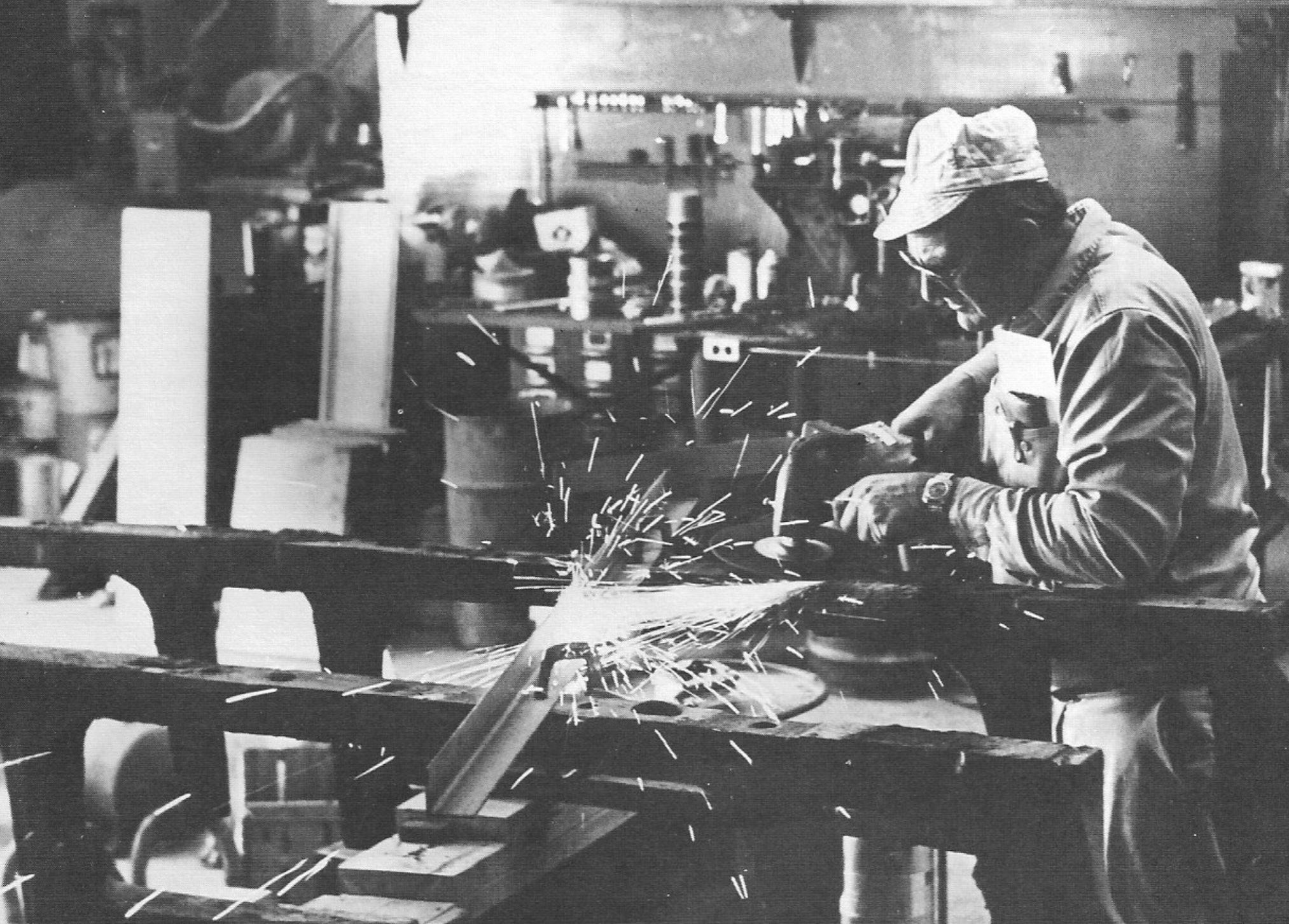
Stan Mathews, pictured above, was President of Midwest Central Railroad
in Mount Pleasant, Iowa, during the time of the Mark Twain Zephyr.
One of the problems was the track owned by the Midwest Central Railroad was narrow gauge, while the Mark Twain Zephyr was standard gauge. This meant a special track would of had to be constructed to provide rides on the Mark Twain Zephyr. Many of the members of the Midwest Central Railroad did not have interest in spending much money, nor time, on the Mark Twain Zephyr because it was considered "too modern"... and did not fit in with the older steam locomotives they enjoyed working on. Thus, little to no work was done on the Mark Twain Zephyr train set during the late 1960s and early 1970s. A photo (below) shows that the train had multiple broken windows and other problems with the interior.
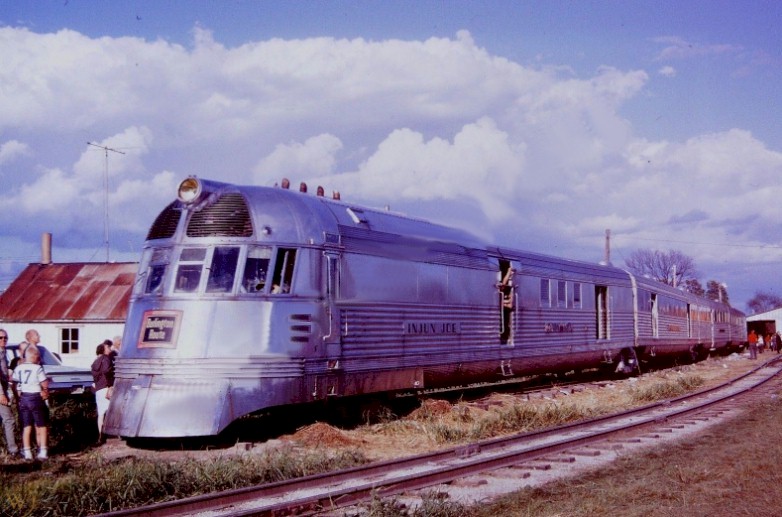
Here is a copy of a slide taken in Summer 1968 when the Mark Twain Zephyrr was on display at Midwest Central Railroad in Mt. Pleasant, IA. (Courtesy: Midwest Old Settlers & Thresher Association)
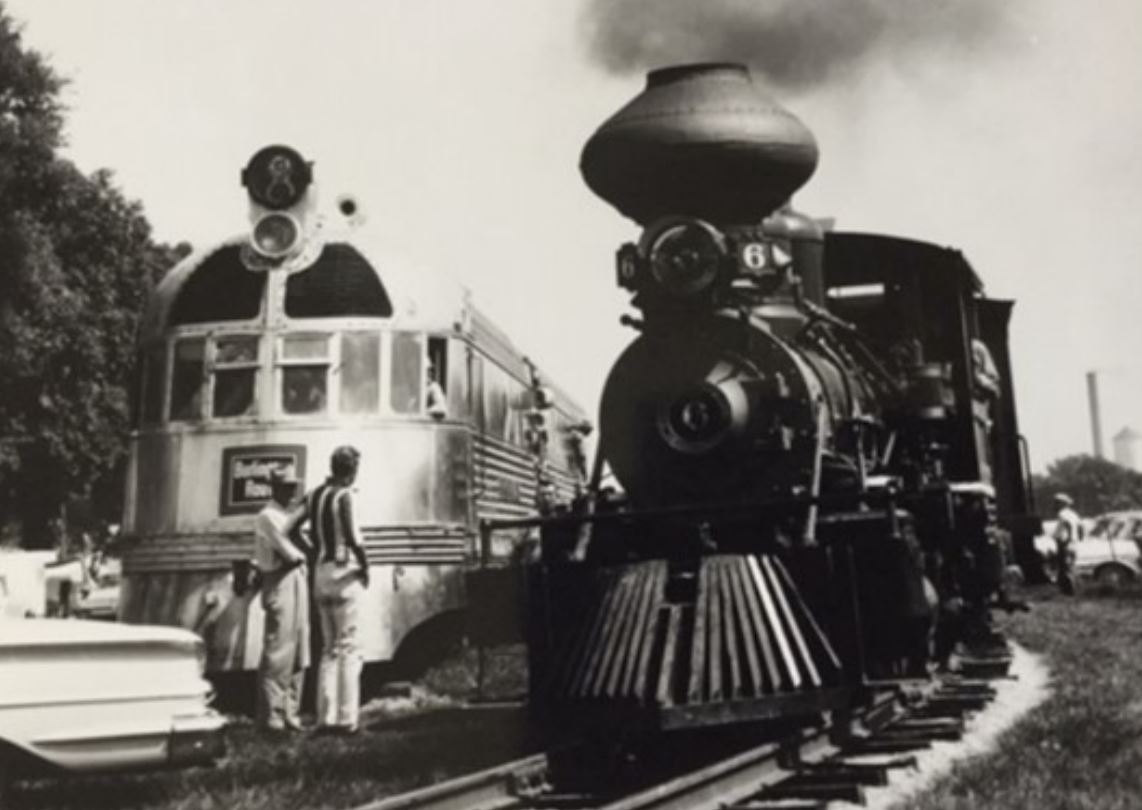
Unfortunately for the Mark Twain Zephyr, the steam program at the Midwest Central Railroad seemed to draw more attention than the former Burlington streamliner did.
A portion of the article reads, "The great streamliner still sits on her side just where they first put her. Vandals have smashed out most of the half-inch thick windows, causing thousands of dollars' worth of damage. The siding (which the Mark Twain Zephyr had been parked on) has sunk into the ground, forcing the big engine to tilt forward, her stubby "cowcatcher" jammed into the earth. The flashing headlight that was her trademark has been broken and is rusting. Weeds reach halfway up her tarnished sides. Many of the windows have been covered up with sheet metal. Some of the once-posh coaches are a jumble of upended seats and storage items."
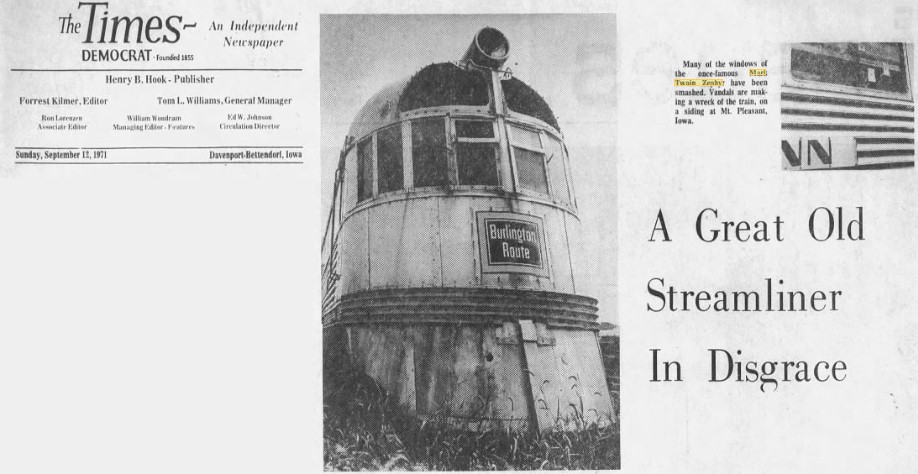
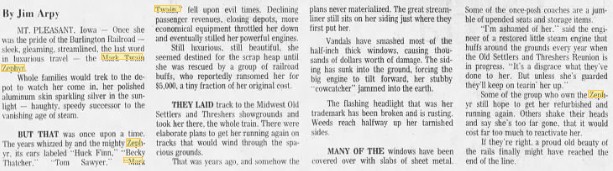
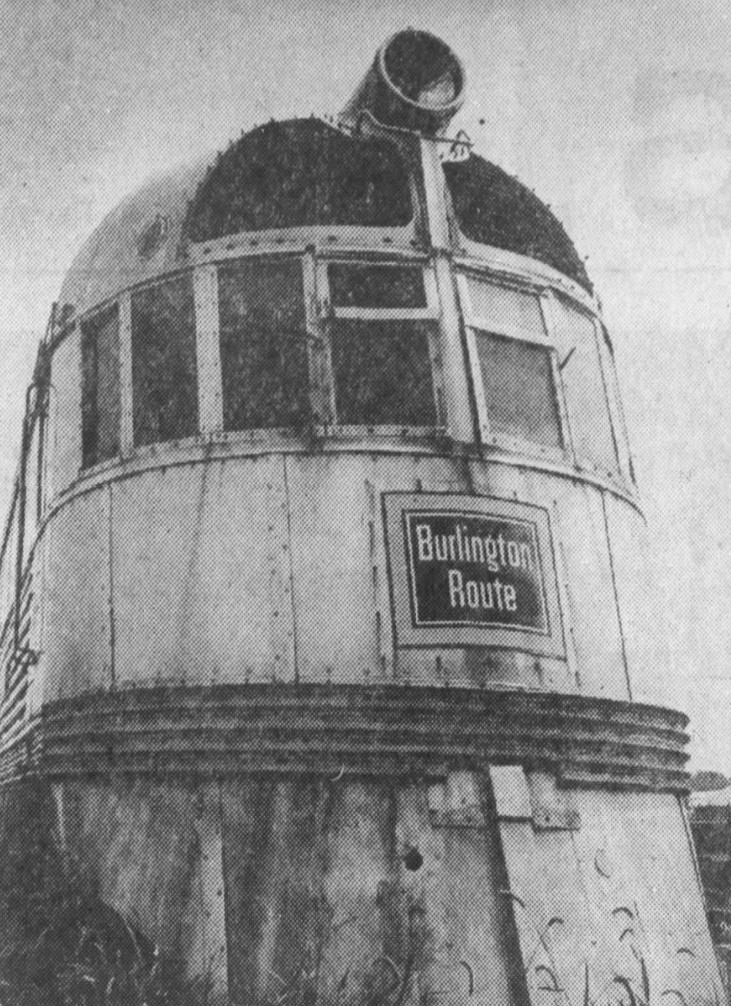
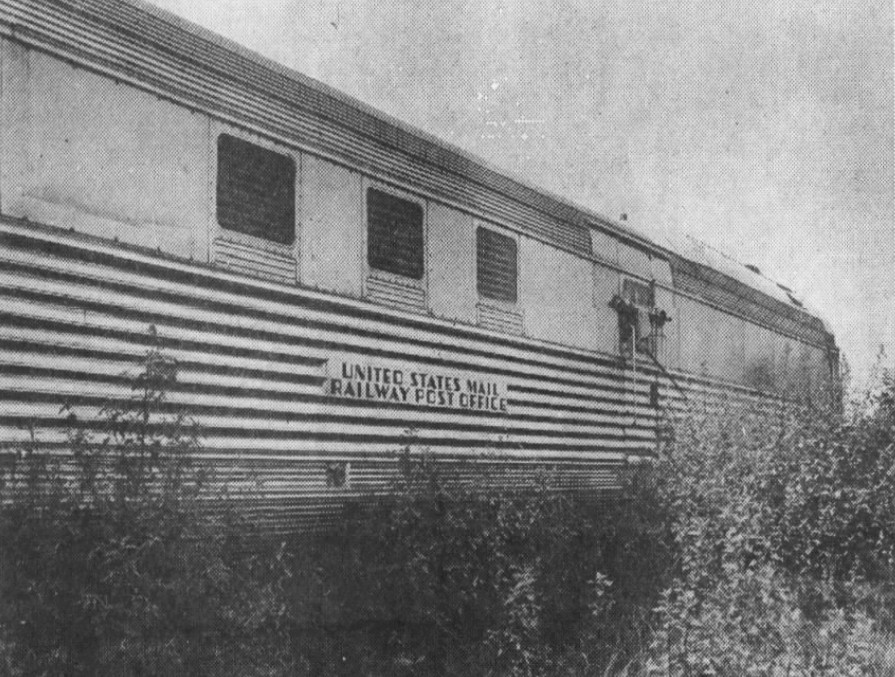
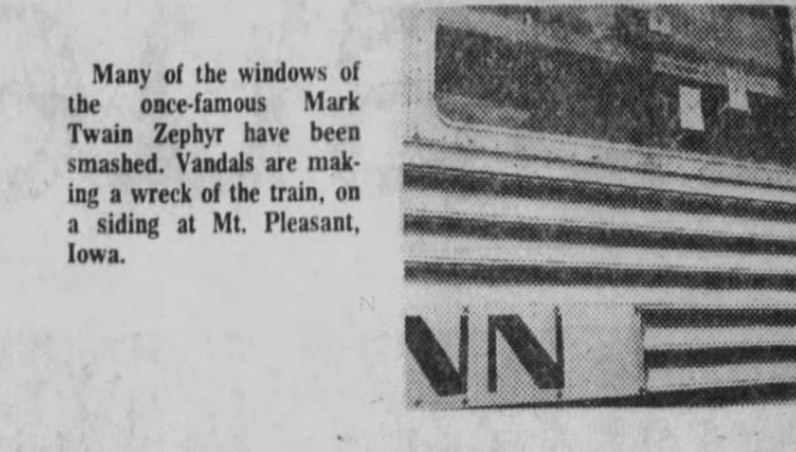
A 1971 newspaper article drew attention to the historic Mark Twain Zephyr
(Courtesy: Quad Cities Times Archives)
Midwest Old Settlers & Threshers Association
(December 1974 - June 1979)
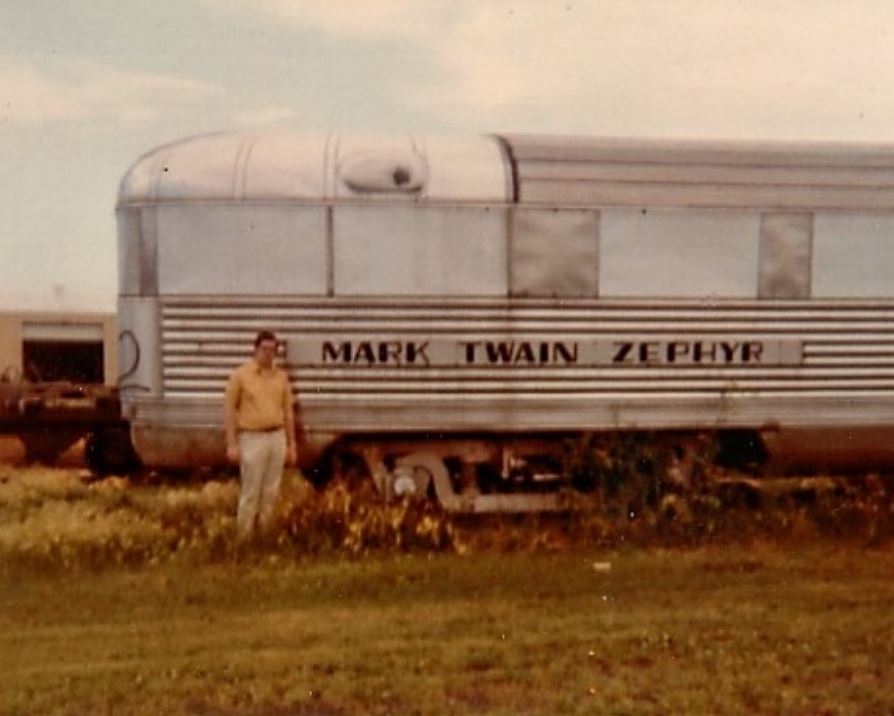
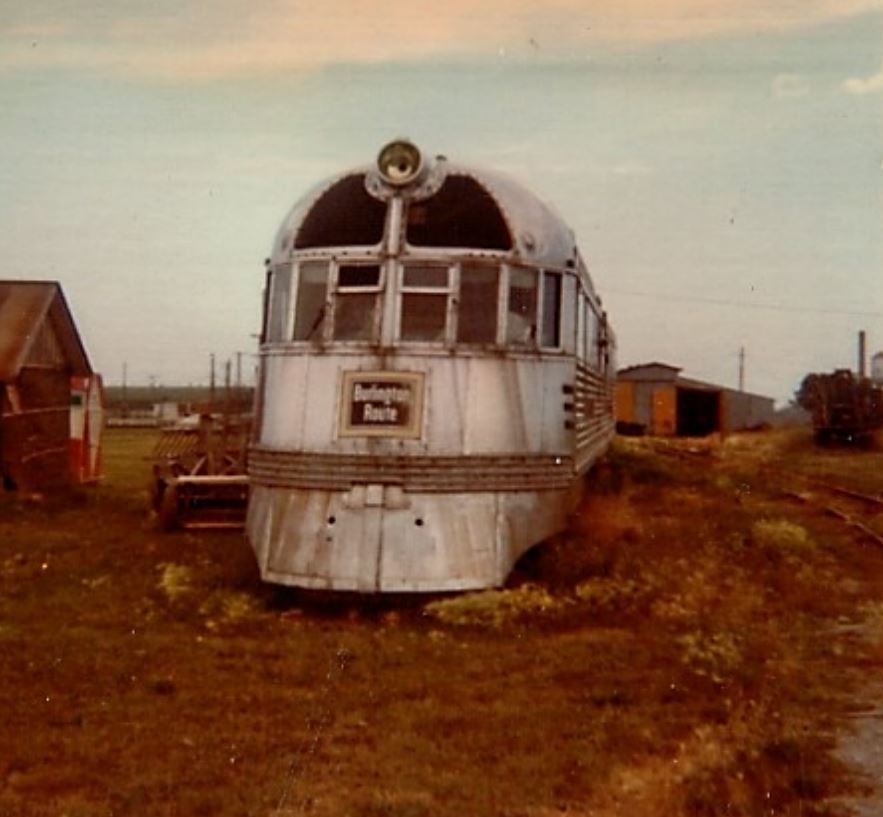
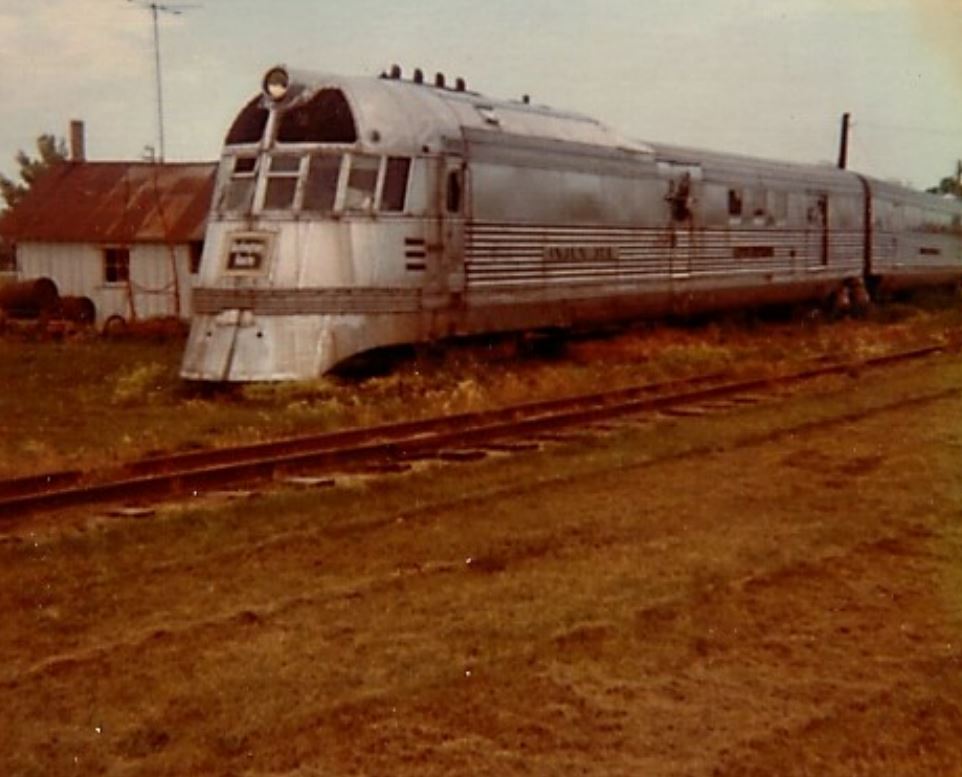
 .
.
This series of photos taken when the Mark Twain Zephyr was owned by the
Midwest Old Settlers & Threshers Association show its deterioration.
(Courtesy: Becker Spaun)

Lennis L. Moore, pictured above, was CEO of Old Settlers & Threshers Association
in Mount Pleasant, Iowa, during the time of the Mark Twain Zephyr.
Alexander J. Barket, Sr.
(June 1979 - October 1980)
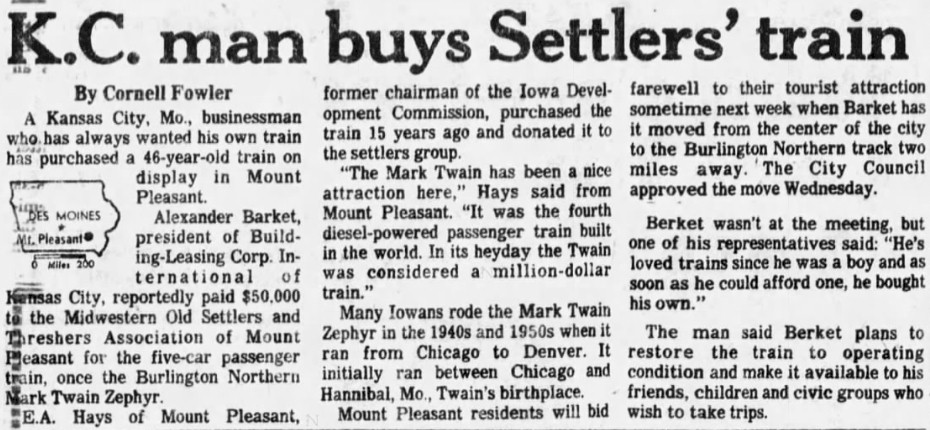
June 7, 1979 edition of the Des Moines Tribune on the Mark Twain Zephyr sale (Courtesy: Des Moines Tribune archive -- newspaper stopped publication in 1982)

Alexander J. Barket, Sr. was the fifth private owner of the Mark Twain Zephyr.

The Texas Zephyr, owned at the time by Alexander Barket, is parked at the old Kansas City Union Station.
(Courtesy: Trainorders.com / JoCoLB)
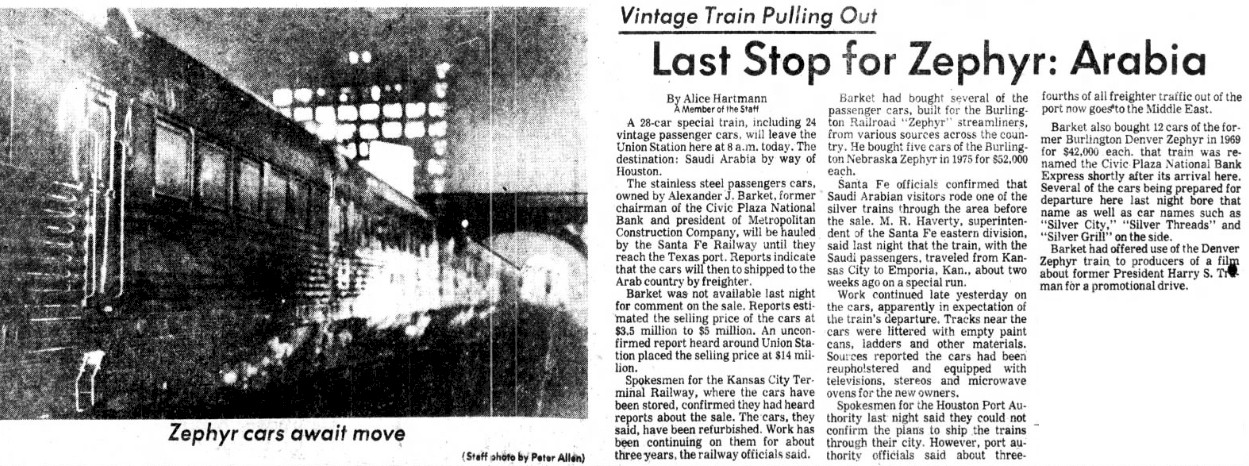
The October 16, 1976 edition of the Kansas City Times details the move.
(Courtesy: Kansas City Times Archives)
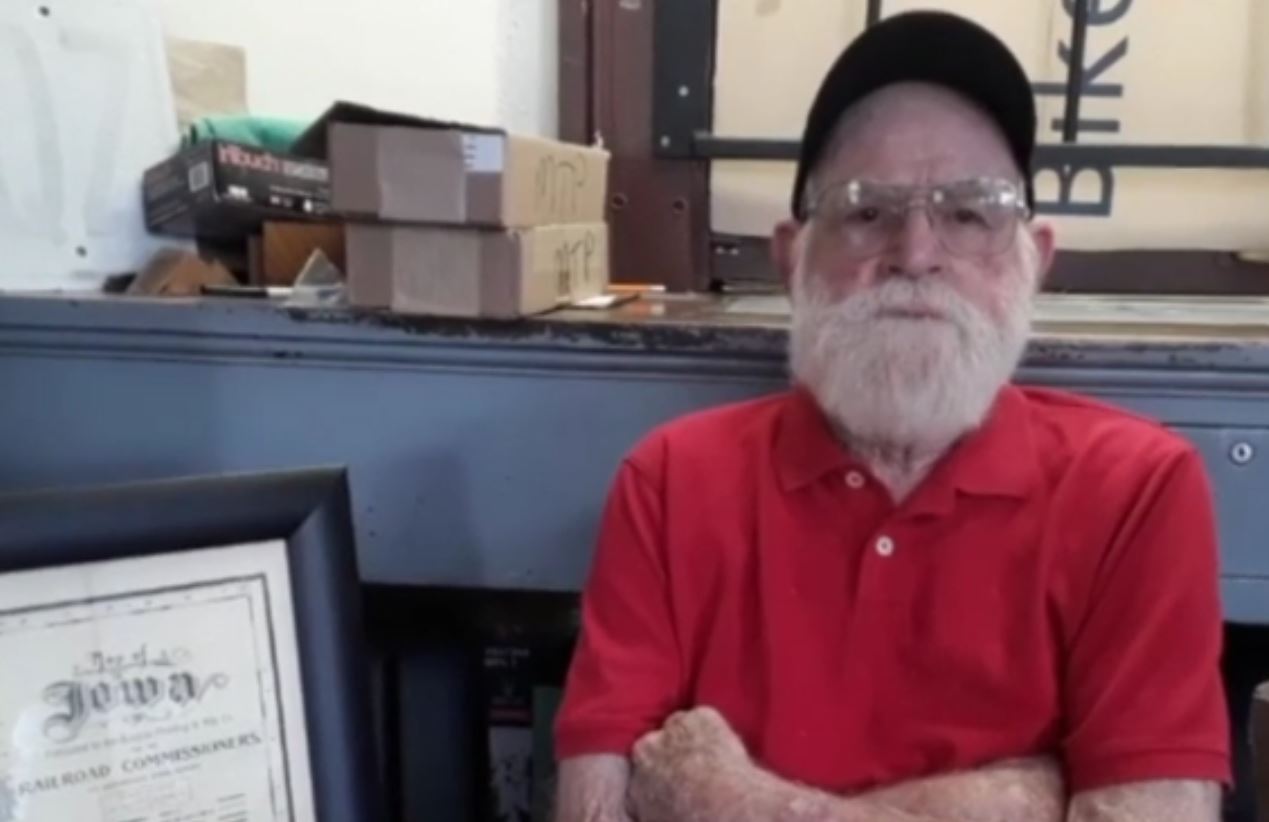
Gerald "Skeeter" Hidy, pictured above, was contracted by Old Settlers and Barket
to move the Mark Twain Zephyr through Mount Pleasant in July 1979.
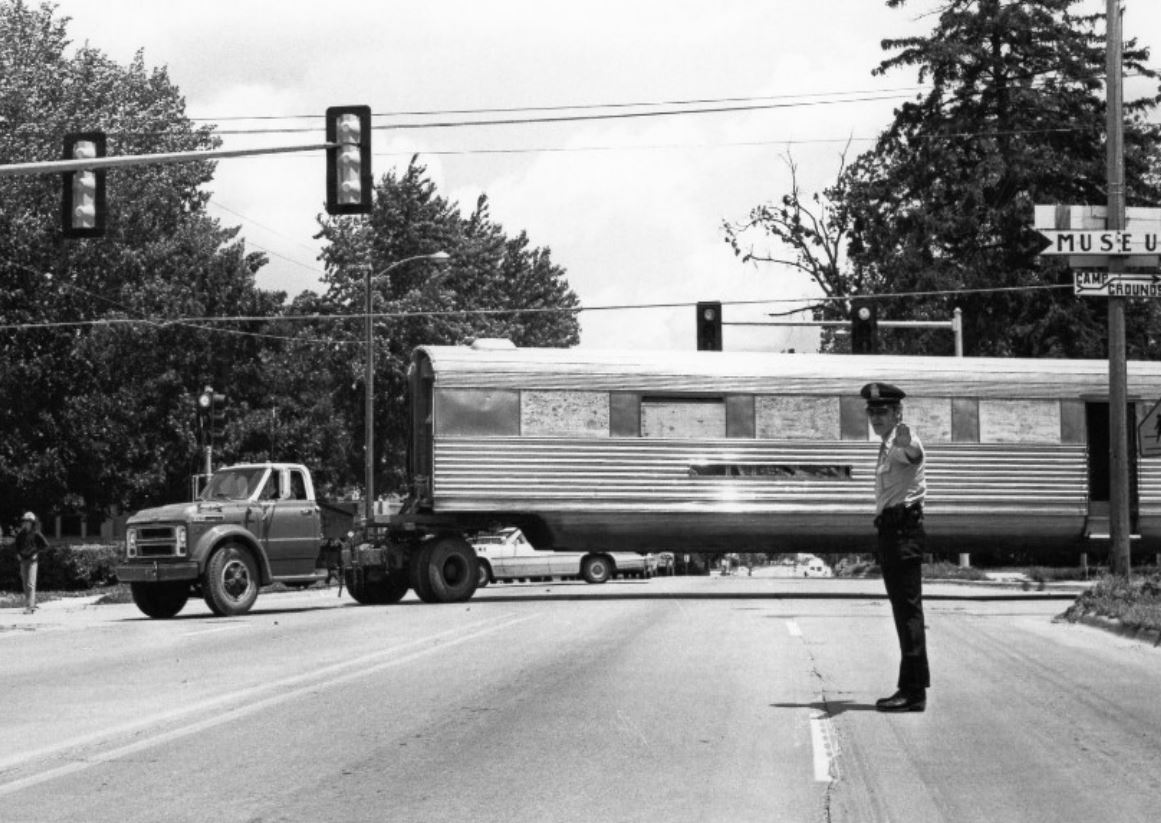
The Mark Twain Zephyr moves through Mount Pleasant in July 1979.
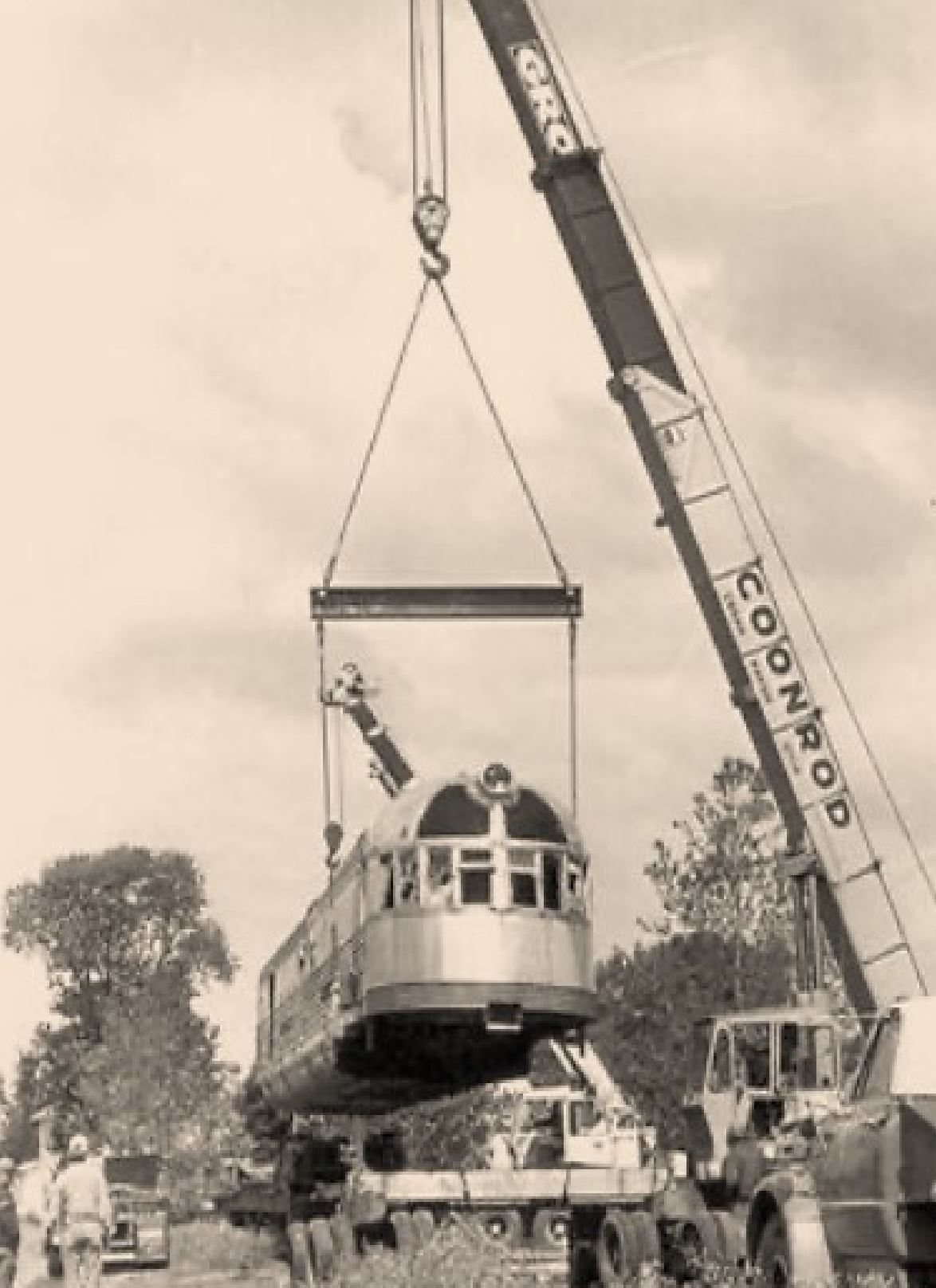
A crane owned by Virgil Coonrod was used to lift the Mark Twain Zephyr
onto flat cars at the Burlington Northern siding at Mount Pleasant in July 1979.
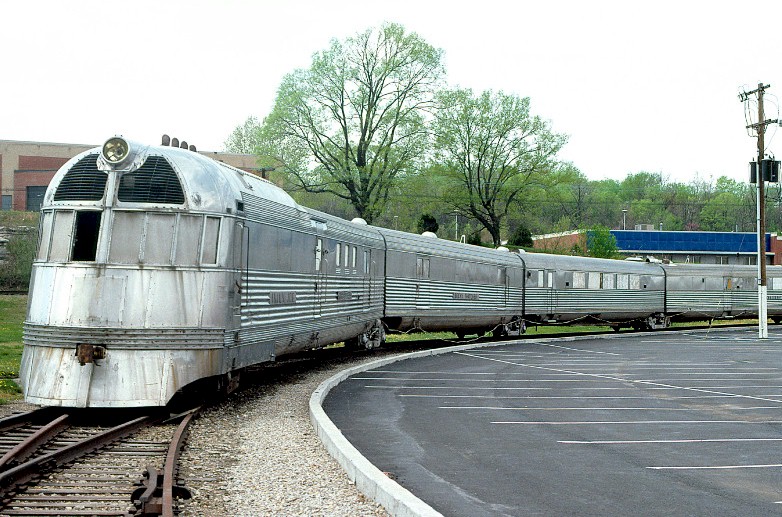
The Mark Twain Zephyr, as seen in 1980 in Kansas City, Missouri.
(Photo courtesy: Chuck Zeiler)
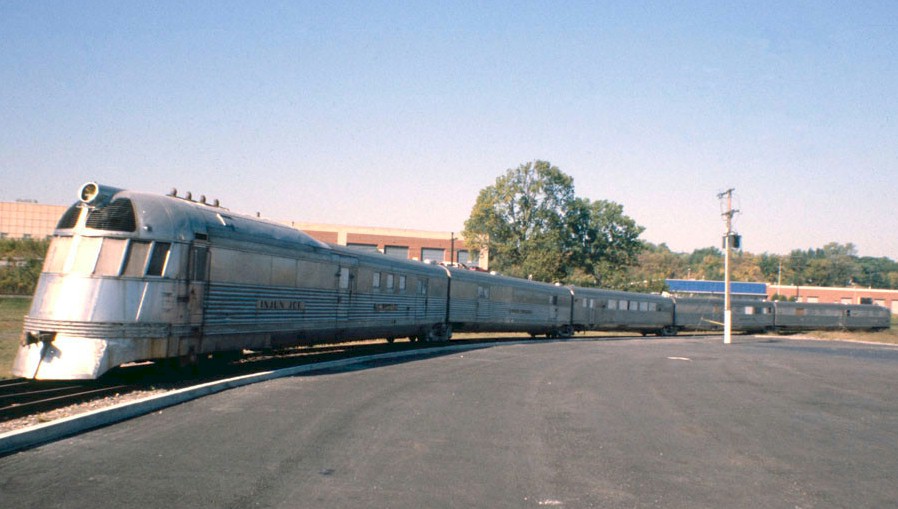
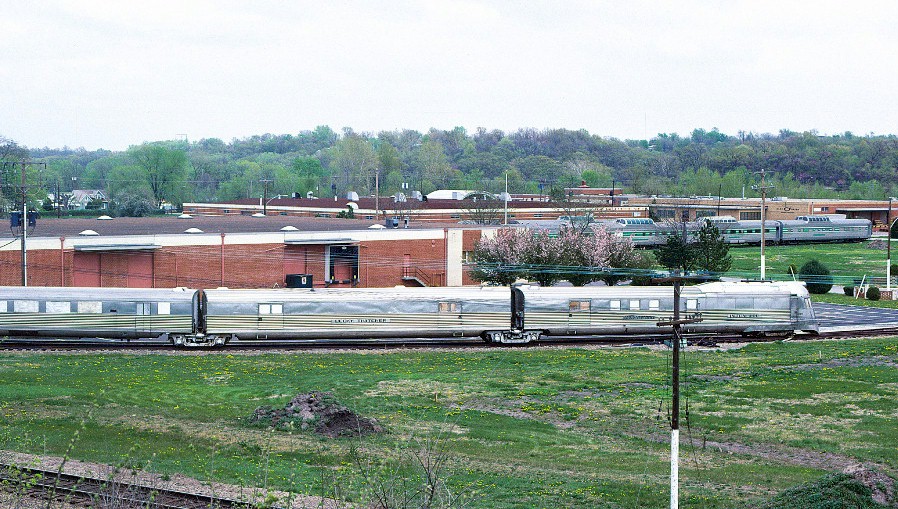
The Mark Twain Zephyr, as seen in 1980 in Kansas City, Missouri.
(Photo courtesy: Chuck Zeiler)
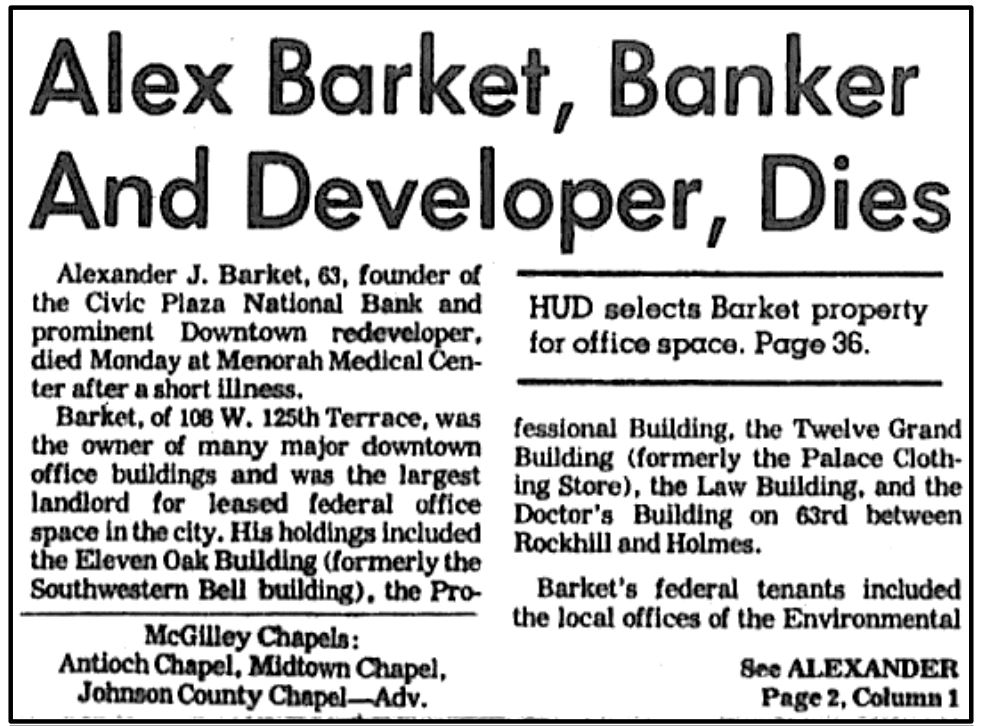
Alexander Barket, Sr., died in July 1979,
as the train was being moved from Iowa to Missouri.
Westgate Bancshares, Inc.
(October 1980 - September 1983)
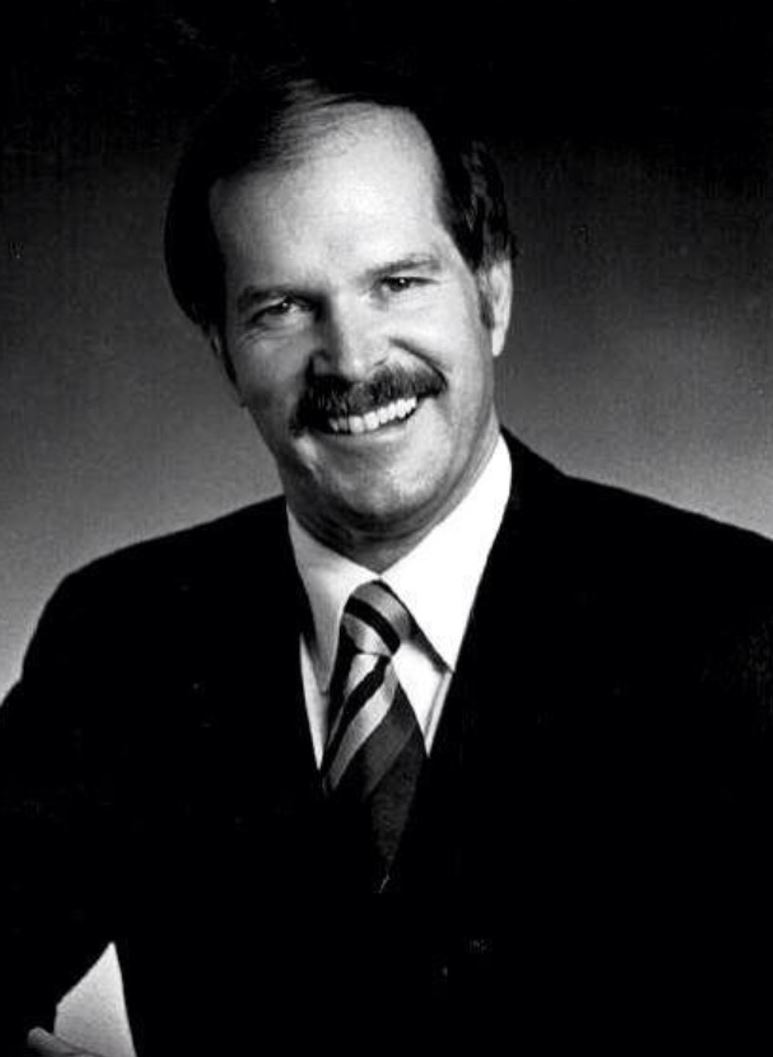
Clarence Wilson, pictured above, was President of Westgate Bancshares, Inc.
during the time the organization owned the Mark Twain Zephyr.
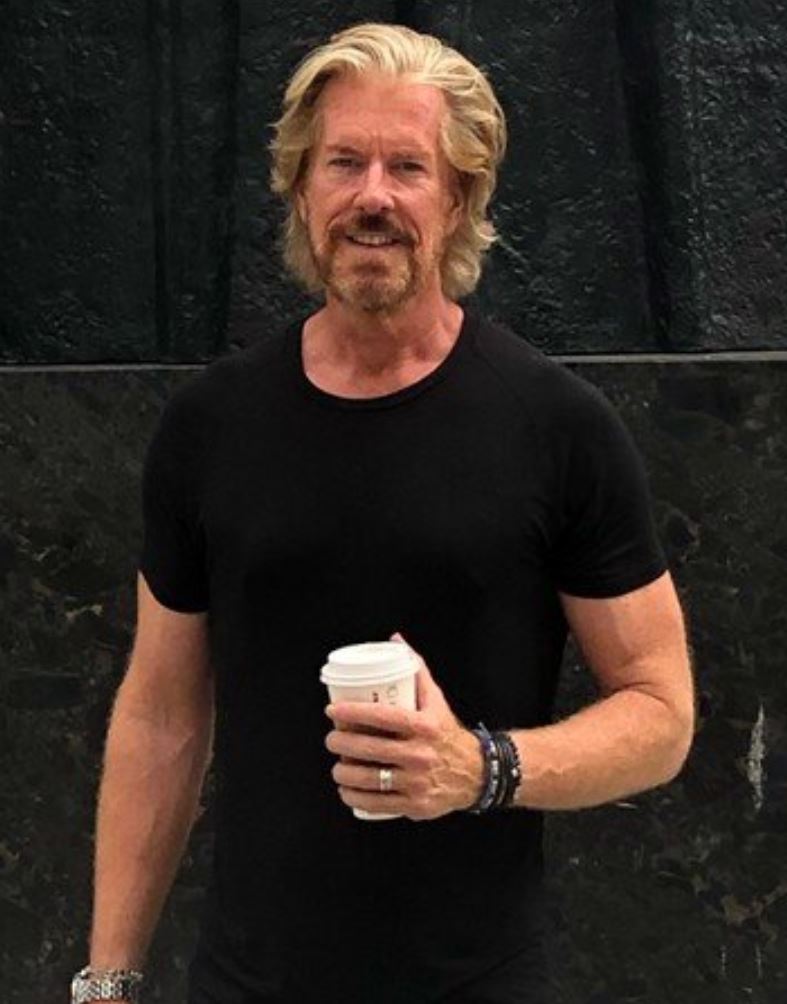
Ken Wilson, pictured above, was Vice President of Westgate Bancshares, Inc.
during the time the organization owned the Mark Twain Zephyr.
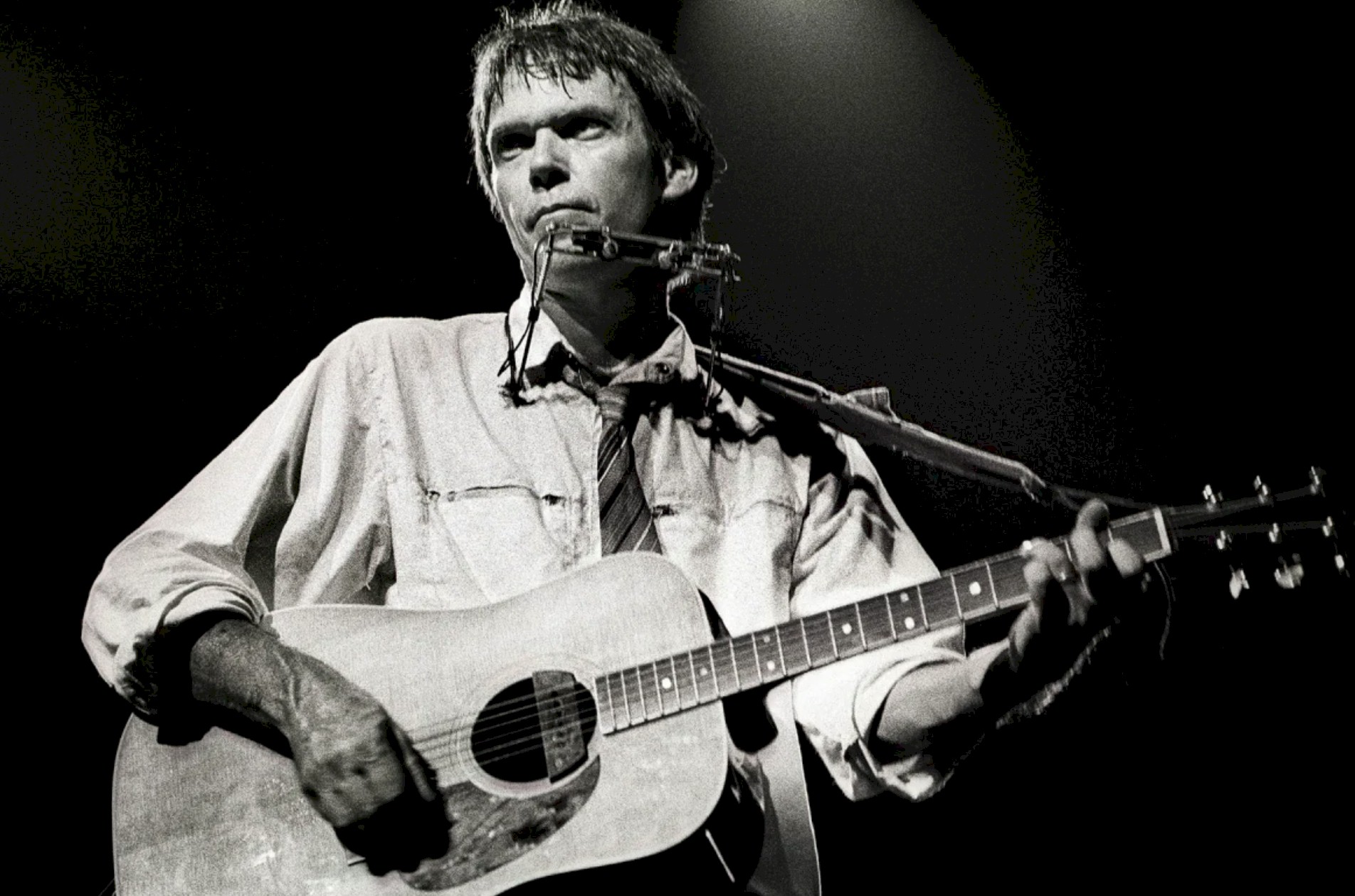
Musician Neil Young, picture above, flew to Kansas City
and considered buying the Mark Twain Zephyr in the early 1980s.
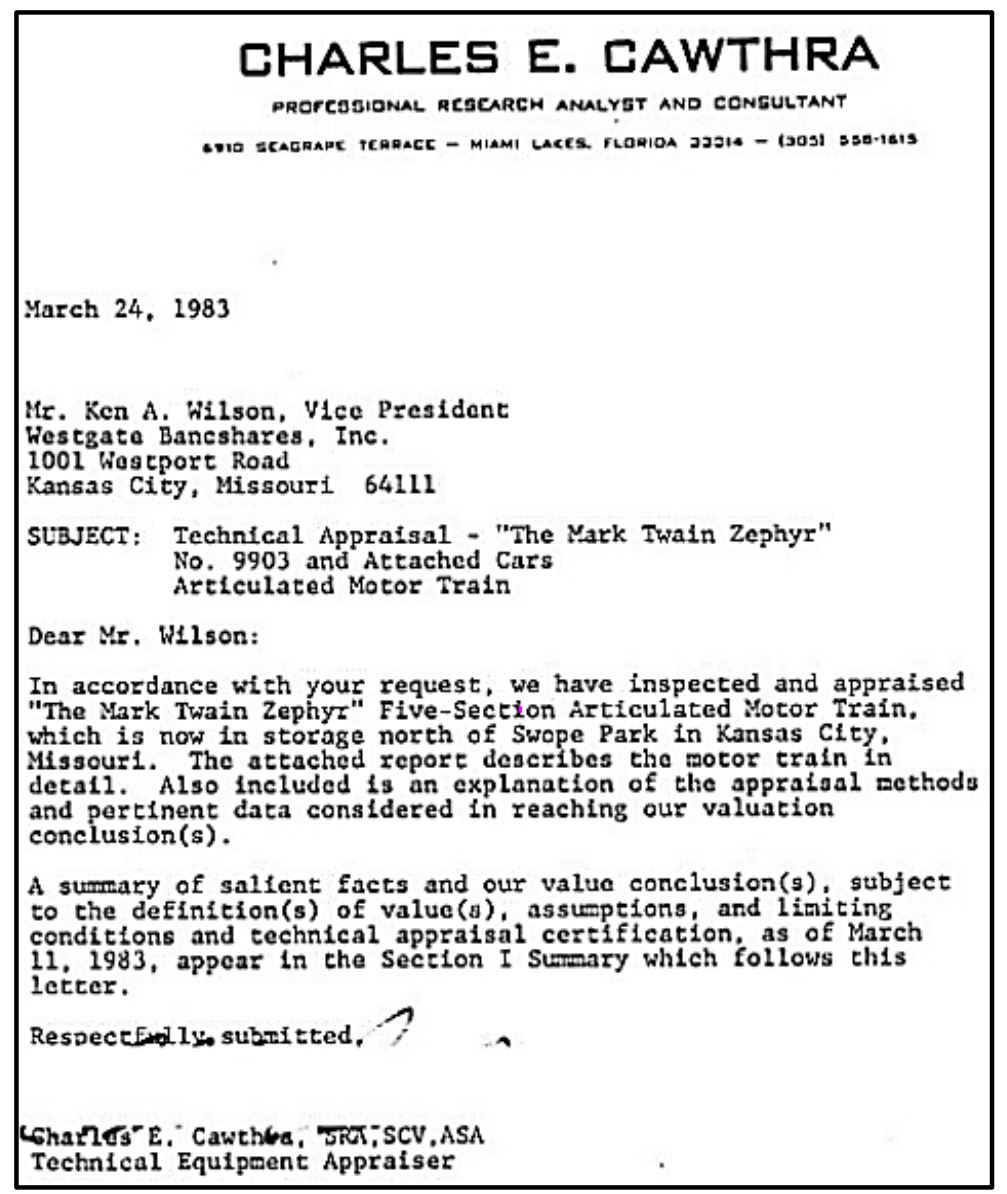
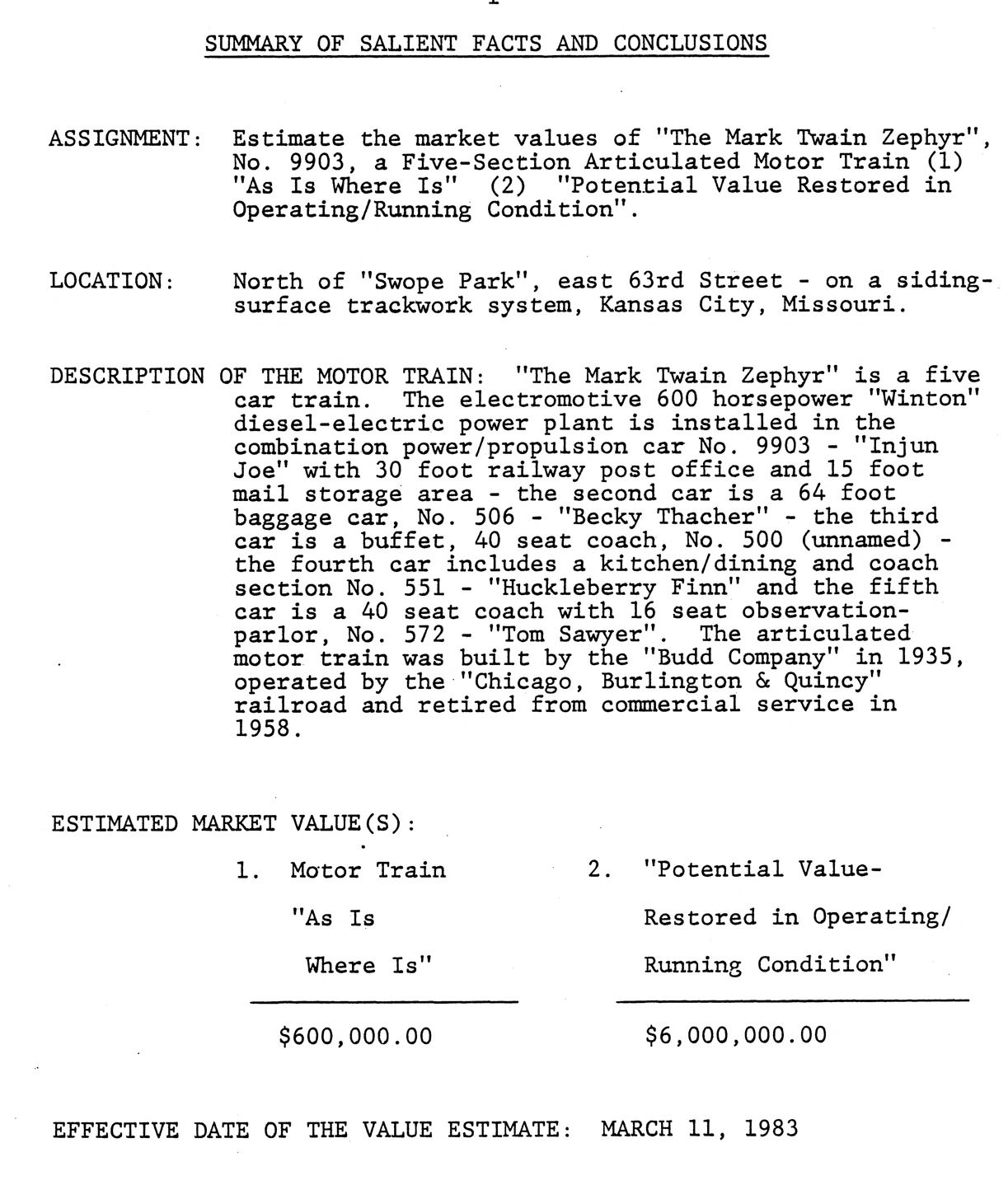
Above are two pages from the 1983 appraisal of the Mark Twain Zephyr.
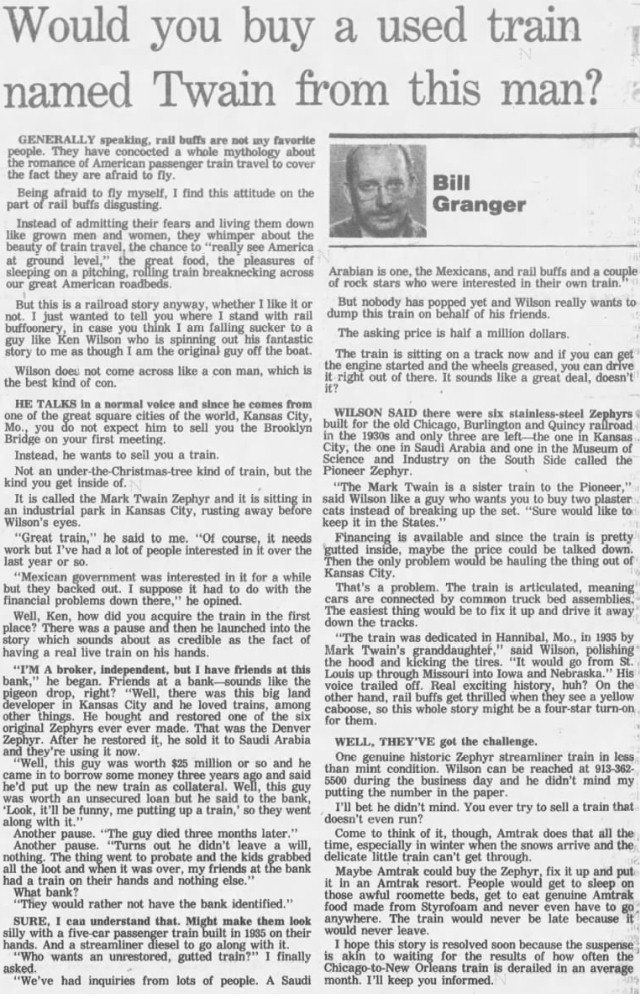
An article in the February 1, 1983 edition of the Chicago Tribune on the MTZ
(Photo courtesy: Chicago Tribune Archives)
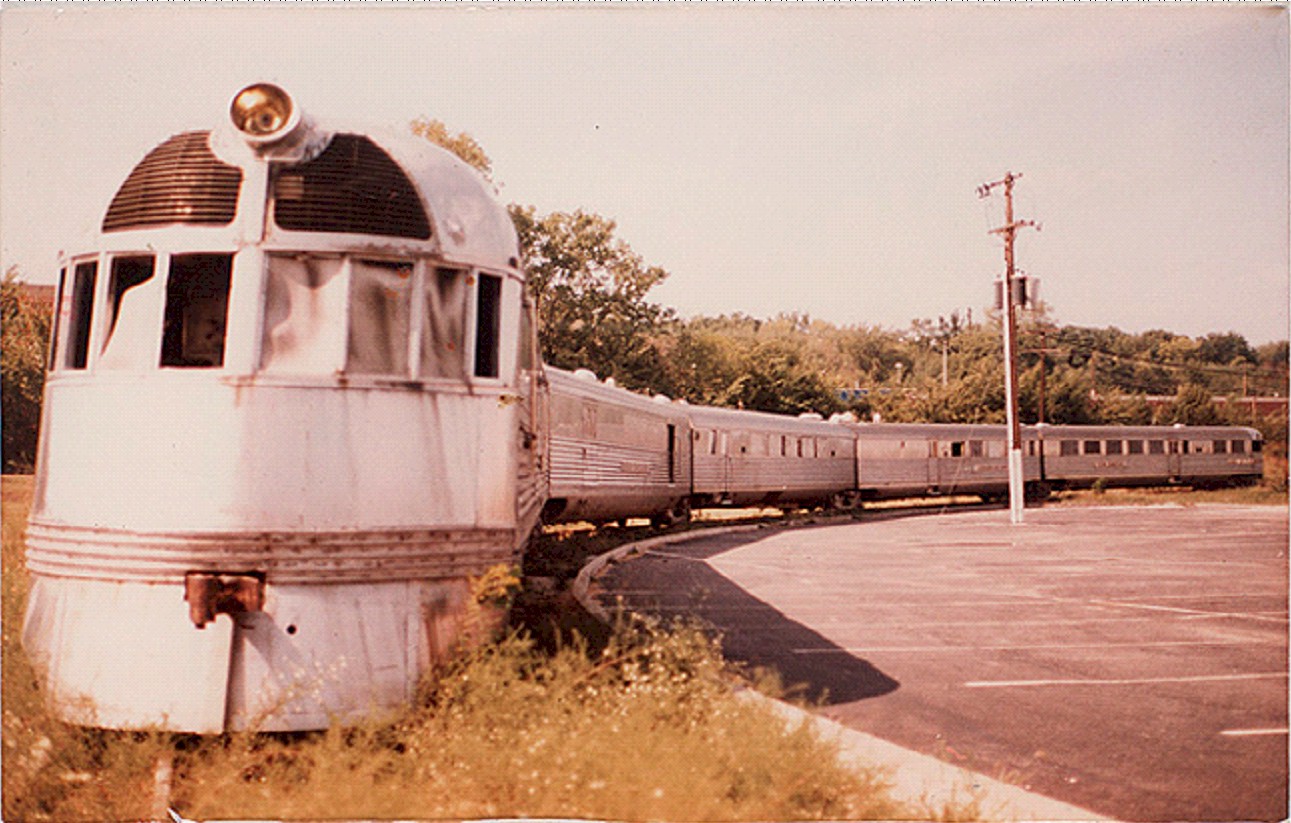
A 1983 photo shows the Mark Twain Zephyr parked on a siding in Kansas City.
(Courtesy: David Carnen)
David L. Simpson
(September 1983 - January 1987)
